

If you have spent any amount of time online recently, you would have probably seen the term ‘Mewing’. Whether it’s about the rapidly evolving ‘looksmaxing’ community or orthodontic discussion boards, it’s about time we broke down exactly what Mewing is.
Popularised by British orthodontist Dr John Mew and promoted online by his son, Dr Mike Mew. Mewing is a technique that has been suggested by some to potentially influence facial aesthetics, especially the jawline, by placing your tongue flat against the roof of your mouth.
As a Sydney orthodontist based in Canterbury and Parramatta, we have seen a rise in the popularity of Mewing, especially among teenagers and young adults.
In this blog, we will break down what Mewing is, whether it really works, and which orthodontic treatments may be more effective than Mewing.
Where Did Mewing Come From?
As previously mentioned, Mewing was invented by British orthodontist Dr John Mew in the 1970s. It became a key component of his “orthotropics” practice.
Dr Mew wanted to develop a method that not only improved facial aesthetics but also structure through correct oral posture.
Mewing is based on the belief that proper tongue placement exerts gentle, continuous pressure on the upper jaw (maxilla), which can influence overall bone structure and facial form.
It is important to note that while both Dr John Mew and Dr Mike Mew stand by their views on oral posture, Mewing has frequently been questioned by professional orthodontists.
Dr John Mew had his dental licence revoked by the General Dental Council in 2017, and Dr Mike Mew was dropped from the British Orthodontic Society in 2019 for his beliefs and claims about Mewing.
How Does Mewing Work?
Mewing involves positioning your tongue correctly against the roof of your mouth to promote “correct tongue posture”.
The Mewing method consists of a variety of exercises designed to improve your facial and mouth posture. Mewing aims to eliminate the need for surgery to achieve an aesthetically pleasing jawline and counteract the effects of mouth breathing.
How To Do Mewing Correctly?
So how do you actually mew correctly? Well, there are several steps to follow to get yourself Mewing correctly according to those who believe in the practice.
- Step 1: Set your head and neck first. Stand or sit tall, gently lengthen the back of your neck, and keep your chin up (not tilted though).
- Step 2: To begin, gently close your lips until they are gently sealed, but not tight.
- Step 3: From here, raise your entire tongue and place it on the upper palate (roof of the mouth), ensuring it is relaxed.
- Step 4: Finally, to perform Mewing correctly, position the tip of your tongue on the gum line behind your front teeth. You do not want your tongue, however, to touch your front teeth.
- Step 5: With your tongue up, perform a tiny “suction hold” by lightly pressing your tongue to the palate and sealing the lips. Overall, it should feel as if the tongue is stuck up there without discomfort.
- Step 6: Keep your tongue up and breathe calmly through your nose.
- Step 7: You want to begin to make Mewing your normal resting posture. The goal is to keep your tongue up, your lips closed, your jaw relaxed, and have you breathing through your nose in everyday life.
You can progress by Mewing for longer intervals multiple times a day as you work towards making Mewing your resting posture.
What Are The Benefits Of Mewing?
While Mewing, as it relates to orthodontics, continues to be a growing craze, there is little to no scientific evidence that such a method is actually effective for your orthodontic development.
But what are the reported benefits of Mewing as a practice?
| Area of Effect | Potential Benefit | Does It Really Work? |
| Nasal Breathing | Encourages consistent nose breathing | Supports airway function and may reduce dry mouth |
| Posture | Promotes improved head and neck alignment | Often linked to general posture awareness rather than tongue posture alone |
| Jaw Muscle Tone | Mild muscle engagement under the chin/jaw | May create slight firmness but not structural change |
| Facial Development | Supports proper upper jaw growth | Most relevant while bones are still developing |
| Oral Habit Correction | Reduces mouth breathing and tongue thrust | Habit correction can have functional benefits |
| Jawline Definition | Subtle visual improvement (from posture/muscle tone) | Dramatic changes are unlikely without orthodontics or surgery |
| Structural Facial Change | Significant reshaping of the jaw or cheekbones | In adults, very unlikely without medical intervention |
Again, it is important to take a lot of the supposed benefits of Mewing with a grain of salt, as there is not enough evidence to support the Mewing craze for your jawline or as a form of orthodontic treatment.
The Role of Tongue Posture in Orthodontics
Tongue posture is considered very important in orthodontics. While orthodontic treatment can correct jaw and bite issues, an incorrect tongue position may contribute to relapse over time.
This is why specialist orthodontists assess oral habits and tongue posture as part of a comprehensive diagnosis.
At Ortho Co, Dr Doreen assesses every patient’s tongue posture and habits to create a customised plan if the tongue may be contributing to the malocclusion or affecting long-term stability.
Additionally, orthodontic research shows that in order for facial changes to occur, a constant orthodontic force usually needs to be applied for the majority of the day (often around 22 hours).
This is why appliances such as functional appliances, expanders, braces or clear aligners are designed to apply consistent, controlled forces over time.
In comparison, it is very difficult to maintain a perfect tongue position all day, as we naturally need to talk, swallow and eat.
Orthodontic appliances can therefore provide more reliable, continuous force than relying on conscious tongue positioning alone.
Common Mistakes With Mewing
Several common mistakes occur among people practising Mewing, according to the community that supports the practice.
These mistakes include:
- Pushing the tongue against your teeth can cause tooth movement or soreness.
- Clenching your jaw to “hold it”.
- Pressing hard on the palate can cause fatigue and headaches.
- Only the tip of the tongue is up, with the back of the tongue dropped.
- Mouth breathing while trying to mew (works against the purpose).
Does Mewing Really Work?
So does Mewing actually work as an orthodontic treatment or face-shaping strategy?
Well, maybe to a certain extent, but the research remains limited.
As of 2026, there is a lack of high-quality evidence showing that Mewing alone can cause major facial changes in adults.
Even though there appear to be many before-and-after photo examples showing the transformative power of Mewing, many are not entirely truthful and often influenced by lighting, weight loss, posture, or natural maturation.
There may be real-life cases of dedicated mewers developing stronger facial structures over time, but almost all of these stories are anecdotal.
Is Mewing Safe?
Mewing is considered relatively harmless when performed without excessive clenching.
In extreme cases, people have reported misaligned teeth, misaligned upper or lower jaw, temporomandibular joint pain or dysfunction, loose teeth when Mewing is performed incorrectly.
If you’re looking for a pathway to significant, permanent facial changes, you are much better off consulting a professional orthodontist than relying on an unverified technique such as Mewing.
What Are Alternative Treatments For Jawline Enhancement?
Compared to Mewing, there are many more effective, industry-backed orthodontic and surgical options for people looking for real structural jawline enhancement.
These techniques not only put your health and safety first but also increase the likelihood of achieving lasting, successful results.
Some of the most effective treatments for jawline enhancement include:
- Functional Appliance Therapy (Growing Patients): For children and early teenagers who are still growing, functional appliances can be used to guide jaw development and improve facial balance and may give the results you are looking for if you are considering Mewing. These appliances work by gently encouraging the lower jaw to grow forward or helping the jaws develop in better harmony during growth. Because treatment is timed with natural growth spurts, functional appliances can create meaningful improvements in jaw projection and profile that are not possible once growth has finished.
- Palatal Expansion: Often used for younger patients who are still growing. Palatal expansion devices work to widen a narrow upper jaw,and may help to improve facial symmetry especially if there is a functional shift of the jaw, and may enhance cheekbone support in patients with a small set-back upper jaw. It can also subtly broaden the midface structure, and is often used for people with a narrow palate, crossbite, and airway issues.

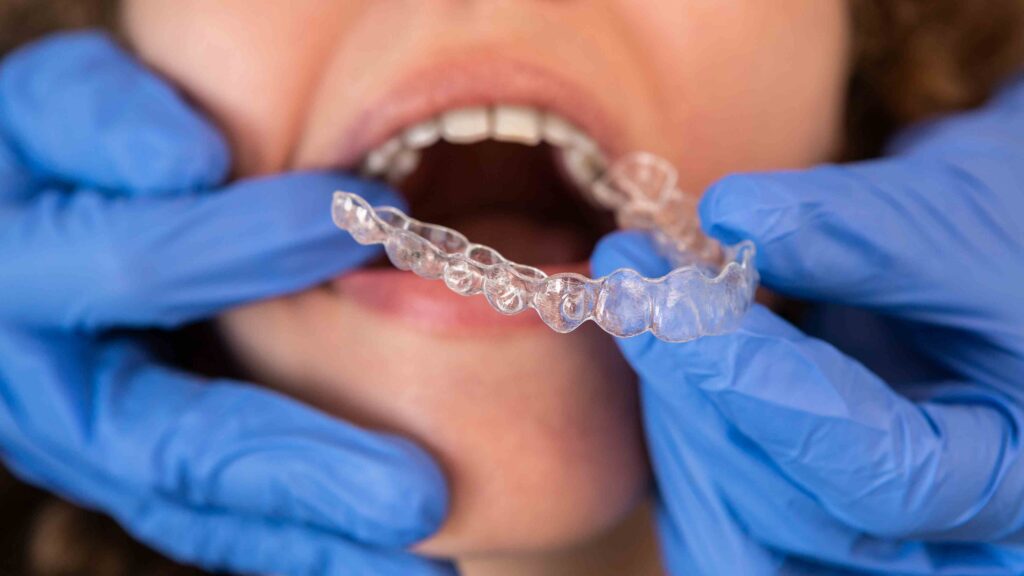
- Braces or Clear Aligners: Both are highly effective orthodontic treatments for straightening teeth and correcting overbites, underbites and crossbites. By properly repositioning the teeth and normalising the bite, braces and clear aligners may improve facial balance and side-profile harmony in certain cases where the teeth have caused facial disharmony.

While they don’t alter the size of the jawbone itself, they may create a noticeable mild to moderate enhancement in jawline definition when recession or imbalance is primarily driven by teeth misalignment.
Invisalign clear aligners offer a more subtle and discreet method to improve jaw alignment, and may help create a more defined jawline without having to use visible traditional braces in certain cases, especially if growth is still present.
- Orthognathic Surgery: Otherwise known as jaw surgery is performed by an oral and maxillofacial surgeon. Jaw surgery is usually combined with orthodontic treatment to align both the teeth and bite to achieve facial harmony. During an orthognathic procedure, your upper and/or lower jaw will be moved forward or back or even widened. It is an effective surgery to correct severe jaw misalignment. This surgery is a top choice for those with a recessed chin, a severe overbite or underbite, or functional issues with chewing or breathing.
Choose Ortho Co. For Your Orthodontic Needs
The first step to finding the right orthodontic treatment for you is to see one of our specialist orthodontists at Ortho Co. We can walk you through your options and help you choose the right treatment plan.
As experienced orthodontists in Canterbury, we understand that fixing your teeth isn’t just about looks; it can also improve your speech, relieve jaw discomfort, improve chewing, boost your dental health, and elevate your overall confidence.
Mewing remains a popular topic of discussion in the orthodontic world. The lack of scientifically backed evidence supporting the practice, though, means that seeking out proper orthodontic treatment is still your best choice if you want guaranteed results.
If you’ve been putting off starting your orthodontics journey, now is the perfect time to take that first step.
Call and book an appointment today. If you are searching for an orthodontist in Parramatta, Canterbury, Hurstville, Ashfield or wider Sydney, we can help you achieve the smile you’ve always wanted.