
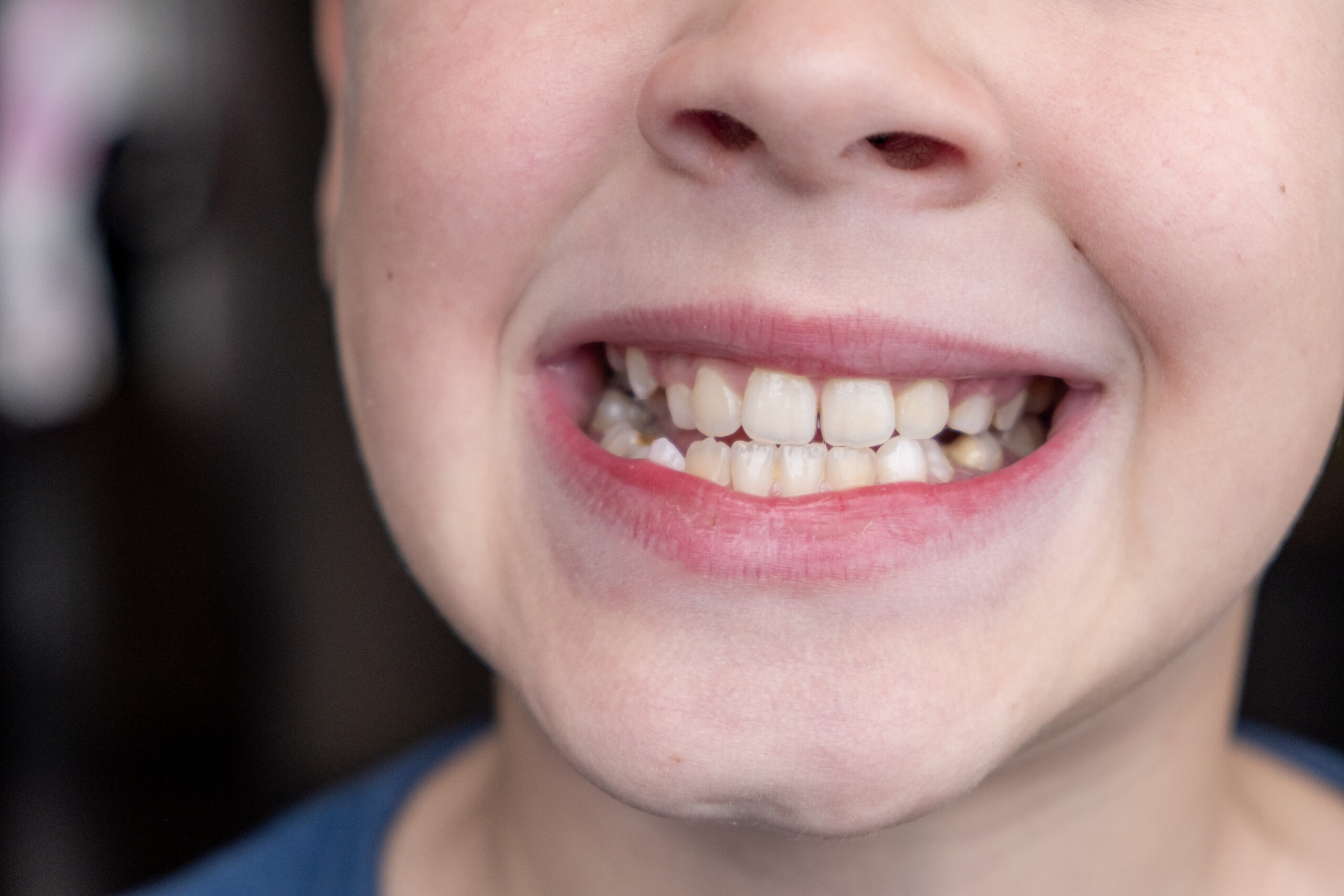
If you’ve ever noticed that your upper teeth sit just inside of your lower teeth whenever you bite down, you may have a crossbite.
It’s a common orthodontic condition, often mistaken for an underbite, and it can occur in people of all ages, all throughout your mouth.
While some crossbites are so mild you may not notice them at first, if left untreated, a crossbite can cause further complications and uncomfortable symptoms down the line.
As orthodontists in Parramatta, we understand that early diagnosis and a personalised treatment plan are essential to correcting a crossbite and protecting your smile for years to come.
In this guide, we’ll explore some of the most common causes and symptoms of a crossbite, what it means for your oral health, and how your orthodontist can help resolve your misaligned bite.
What Is a Crossbite?
A crossbite is a type of dental misalignment (or malocclusion) that occurs when some of your upper teeth sit inside or below your lower teeth when your mouth is closed.
Crossbites are fairly common in both adults and children, and generally will benefit from treatment, as this overlap can have a negative impact on your overall oral health over time.
How Does a Crossbite Affect Your Teeth and Jaw?
The overlap of your upper and lower teeth from a crossbite can cause issues across both your teeth and jaw.
This is primarily due to growth and the repeated forces and pressures of daily use, whether from eating or grinding, and can result in:
Long-term crossbite effects on teeth
- Uneven wear
- Gum problems (such as recession)
- Cracked or loosened teeth
- Increased cavity risk
- Issues chewing or making certain sounds while speaking
Long-term crossbite effects on the jaw
- Jaw favouring one side
- Imbalanced facial structure
- Headaches and strain
- Difficulty opening and closing your mouth
- Temporomandibular joint (TMJ) disorders
Types of Crossbite Teeth
Dentists and orthodontists primarily use a few main classifications when diagnosing a crossbite, and these are based on which upper teeth have been affected.
Anterior Crossbite
An anterior crossbite occurs when one or more of your upper teeth sit behind your lower front teeth, and can resemble an underbite.
However, they are not the same, as an underbite occurs when your entire lower jaw and front teeth are in front of your upper ones.
Posterior Crossbite
A posterior crossbite is when your upper back teeth (like your molars and premolars) sit inside your lower back teeth.
It can often lead to difficulty while chewing and can sometimes be harder to identify without a dental examination, due to its position at the back of the mouth.
Unilateral Crossbite
A unilateral crossbite is when only one side of your mouth is affected by the malocclusion, and is the most common cause of facial asymmetry from a crossbite.
Bilateral Crossbite
A bilateral crossbite occurs when both sides of your mouth are affected by the misalignment, and is often the result of a narrow upper jaw.
What Causes a Crossbite?
Most crossbites are caused by dental or skeletal discrepancies (dental involving one or two teeth, and skeletal involving multiple teeth) during your childhood or adult years.
However, there is no one way to develop a crossbite, as crossbites can be due to a range of genetic, developmental, and environmental factors.
Many habits and dental conditions from childhood can contribute to an increased risk of crossbites in later life, but it is still possible for adults to develop a crossbite independently of these early causes.
Some of the most well-known factors behind crossbites in children and adults include:
Common crossbite causes in children
- Genetics — if you or someone in your immediate family has a crossbite, your children may be more likely to develop one too.
- Long-term dummy use — the constant pressure from sucking a dummy (or thumb) can alter the shape and structure of growing teeth.
- Delayed loss of baby teeth — if baby teeth take too long to fall out, the underlying adult (or permanent) teeth can grow in incorrectly.
- Mouth breathing — constantly breathing through the mouth can change how your mouth and tongue rest, and reshape your jaw over time.
- Overcrowding — if your teeth don’t have enough room to grow properly in your mouth, this can force them into unwanted positions.
Common crossbite causes in adults
- Ongoing crossbites — if a childhood crossbite is left untreated, the misalignment will not resolve itself and will follow you into your adult years.
- Missing teeth — when missing teeth are not replaced, neighbouring teeth can shift out of their proper position and may cause a localised crossbite to develop.
- Facial trauma — heavy impact to the face can displace your teeth and jaw, while certain fractures (those involving the jaw’s condyle or joint) can heal in a different position, altering or even misaligning your bite.
What Are the Signs and Symptoms of a Crossbite?
While identifying crossbite symptoms early can help you start treatment before your condition worsens, the signs of a crossbite are not always immediately obvious.
Symptoms will vary from one person to the next, and many will not realise they even have a crossbite until they visit their dentist for a routine dental examination.
For example, if you have a minor malocclusion at the back of your mouth, it may be harder to detect on your own, while a severe misalignment at the front of your mouth will be more immediately obvious to you and your dentist.
As a general rule, however, some of the most common signs of a crossbite in children and adults include:
- Visible misalignment — your teeth may appear visibly out of place, with upper teeth inside or behind the lower teeth when your mouth is closed.
- Uneven jaw — your jaw may sit more to one side than the other when closing, biting, or chewing.
- Facial asymmetry — the lower half of your face may appear uneven, with an uneven jawline, a smile that rises higher on one side, or a chin that doesn’t align with your nose and forehead.
- Impacted speech — certain sounds may be harder to form, leading to an obvious lisp while speaking, or trouble pronouncing certain familiar words.
- Difficulty chewing — you may start to favour one side of the mouth while chewing or eating to avoid pain and discomfort on the other side.
- Accidental biting — you may be biting the inside of your cheeks or tongue more than usual whenever you’re speaking or eating.
- Pain & discomfort — you may experience tightness, tension, and pain in your temporomandibular joint (TMJ) or face and neck muscles.
How to Fix a Crossbite
A crossbite, no matter how subtle or severe, can be treated with the right orthodontic care.
As with many dental conditions, it’s easier to resolve a crossbite when it’s detected early, and early intervention is one of the best ways to support a positive outcome.
How your orthodontist will treat your particular crossbite will depend on several factors, including:
- The complexity of your individual case
- The severity of your misalignment
- Your age (and potential for future oral growth)
- The cause of your misalignment
- Your overall treatment goals
Crossbite Treatment For Children and Adults
While it’s common for orthodontists to recommend braces to fix crossbites, there are other treatment options available, and your orthodontist will work with you to determine what’s best for your bite.
How long it takes to fix a crossbite and the exact crossbite treatment cost will vary depending on your individual circumstances.
However, it generally takes anywhere from 6 months to 2 years for a full crossbite teeth correction.
If you’re wondering “can a crossbite be fixed with braces?” the simple answer is yes.
However, certain treatments are only possible once your teeth and jaw have stopped growing, while others rely specifically on the flexibility of childhood growth to shift your teeth.
Additionally, severe crossbites may require surgical intervention to reset and realign your jaw, with a period of orthodontic treatment (usually in the form of braces or clear aligners in Sydney) to properly resolve your misalignment.
To help give you a better idea of some of the most common crossbite treatments, we’ve prepared this quick summary for you:
| Crossbite Treatment | Best Suited For | How It Works | Average Timeframe | Estimated Cost (AUD) |
| Braces | Mild to moderate cases with a dental cause, and when most permanent adult teeth have grown in | Brackets, wires, and elastic bands guide teeth back into their correct positions with steady, controlled pressure | Minor case: 6–12 monthsModerate case: 12–24 monthsComplex case: 2–3 years | $3,000–$9,000 |
| Aligners | Mild to moderate cases where the misalignment is due to tooth position, not jaw structure | Gentle, focused pressure from aligners across the arch moves misaligned teeth back into their correct positions | Minor case: 6–12 monthsModerate–complex case: 12–24 months | $6,000–$9,500 |
| Palatal expanders | For children aged 7–12 years old and while the upper jaw is still growing (often used with braces in Sydney) | Applies pressure to upper back molars to widen a narrow upper jaw so teeth can overlap in their correct positions | 6–12 months | $2500-$4000 |
| Elastics | Minor, single-tooth cases or for refinement in older patients when bone expansion is not a concern | Elastic bands apply diagonal pulling force between upper (outside) and lower (inside) teeth to guide teeth into proper alignment | 20–22 hours per day (for 2–6+ months) | Often included in the cost of braces or clear aligner treatment |
| Jaw/orthodontic surgery | Severe structural cases, and when facial/jaw growth has completed (usually between the ages of 16–18 for women and 18–21 for men) | The upper or lower jaw is surgically cut and repositioned so the upper teeth properly overlap with the lower teeth (may include refinement with braces) | 18–24 months | $9,000–$15,000 |
Orthodontic Treatments at Ortho Co
If you suspect you or your child may be experiencing the signs and symptoms of a crossbite, or know you’re at a higher genetic risk of developing one, it may be time to book an appointment with your dentist and find out.
As experienced orthodontists in Canterbury, we specialise in supporting healthy jaw growth in children and realigning uneven bites in adults, so your dental concerns now don’t become dental problems later.
A thorough dental examination is the first step in that journey, so if you’re ready to get started with Ortho Co, book an appointment with us today.